
The Impossibility of the Field Goal
I was moved—more like compelled—to write this essay in response to watching Houston Texans place kicker Kris Brown miss an extraordinarily high percentage of the field goals he attempted during the 2009 season, many of them from quite close distances, chip shots in the sporting vernacular. We are not talking baseball here, where the mark of excellence is failing to get a hit only two out of every three attempts. Place kicking in football has evolved to the point where it is now considered largely automatic, particularly for kicks of less than, say, thirty yards. And again employing the baseball analogy where hitting is but one of several tasks entrusted to the players, the field goal kicker does nothing else whatsoever for the team, unless he happens to be walking up and down the sidelines handing out water during the game, which task, by the way, would have significantly enhanced Brown’s value to the Texans this year and likely improved his chances, at least somewhat, of having a contract to continue playing next year. And while the sporting press and fan base, myself included, were quick to vilify Brown for his dismal performance, with the benefit of a bit of hindsight and some cold objective engineering analysis, one realizes the real marvel is that more NFL kickers don’t perform as badly as he did this season.
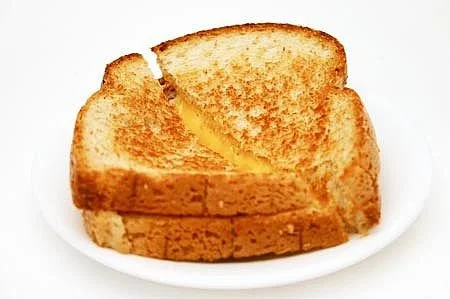
On The Societal and Metaphysical Importance of the Grilled Cheese Sandwich
I will preface this treatise by confessing, right from the get-go, that I am no cook. I survive largely on restaurant food, take-out, and the occasional freezer-to-microwave entrée, the latter only so long as no preparation whatsoever is required aside from removing the item from its container. Case in point: I find it unacceptably laborious to have to remove the round sheet of cardboard from beneath a frozen pizza before placing it into the oven. There exist as well freezer-to-oven dishes (lasagna, casseroles, etc.) whose manufacturers have the temerity to recommend that the contents be stirred at some point in mid-cooking. All of which is a roundabout way of getting back to my principal topic, grilled cheese preparation, and which digression I offer simply as counterpoint to the fact that I take no small amount of pride in the preparation of a palatable if unexceptional grilled cheese sandwich.

Over the Top
Notwithstanding all the tremendously rich and important debates and arguments that take place each day between couples—married or otherwise—about cheating, slovenly relatives, wanting or not wanting children, or whether to work or stay home, I strongly suspect that more relationships fail over one topic than any other, i.e. whether the paper towels and toilet paper should unroll over the top or out from the bottom (hereinafter referred to as the Toilet Paper Issue or TPI). I offer no heuristic data with which to support this assertion, relying instead on personal observation and more than a few anecdotal statements provided by relatives and personal associates. Don’t misunderstand me – the premise in what follows is not that mismatched decisions about TPI are, in and of themselves, an insurmountable source of conflict and ultimate relationship failure. Rather, it is the failure of individuals to maturely and directly discuss and resolve these conflicts, as opposed to engaging in a tit-for-tat pattern of passive/aggressive behavior, that too often leads to conflict and breakdown.

Outcome without Consequence
Outcome without consequence—that’s what it seems to come down to with some kids, teenagers especially. Or at least that’s how it was for the crowd I hung out with back in high school—if, that is, you can call four adolescent boys a crowd. Group would probably be more like it. We most certainly did not comprise a clique, neither in number of members nor unity of purpose or qualification. And we possessed no particular athletic prowess, academic acumen, or entrepreneurial bent that might suggest a logical institution of any sort. Indeed, we were a group only inasmuch as we lived near each other and had more or less congruent views towards authority, sharing a singular enjoyment in the flouting thereof.

The Swain Diet
Having frequently stood in wonder before the capacious bookstore shelves that pitch Atkins, Scarsdale, Cambridge, South Beach, etc., I have long fantasized about writing a diet book of my own—to be called, cleverly, The Swain Diet. It seems a road to certain riches, and if that plethora of available selections is any indication, it would appear to require precious little thought, preparation, or special expertise to crank one out, just the ticket for someone with my work ethic. And the beauty of this industry (and rest assured it is an enormous one) is that it is, to all appearances, completely and indisputably arbitrary and capricious, changing both in time and content from one edition to the next. If you don’t believe it, select any two books from the diet book section and you will, almost with a certainty, find completely contradictory admonitions. This is, self evidently, critical to the continued success of the industry, for if there were, in fact, one truly foolproof way to lose weight, someone would write the book, everyone who wants to would buy a copy, and that would be the end of it.

The Miracle
I was raised in a Baptist church in southern Maine, about which upbringing several things are worth noting to help set the context for the unusual narrative that follows. First, and rather important societally, if not directly, to this story, is to understand that being a Baptist in the north bears strikingly little resemblance to being one in the south. These differences are manifest on multiple levels, most notable being the relative scale and grandeur of houses of worship in different areas of the country. At the risk of over-generalizing, suffice it to say that in the north the Protestant churches are the small ones and the Roman Catholic churches are the large ones. In the southeast, say from Texas eastward, precisely the opposite is the case. In Houston, for example, Baptist churches seating in excess of five thousand are routinely spaced only a mile or two apart, and are as routinely filled to capacity every Sunday morning. Indeed, the largest Houston-area Baptist church resides in a former NBA basketball arena and seats twenty-two thousand. Conversely the church in which I grew up, the subject of this tale, counted themselves fortunate to seat fifty on a good day.