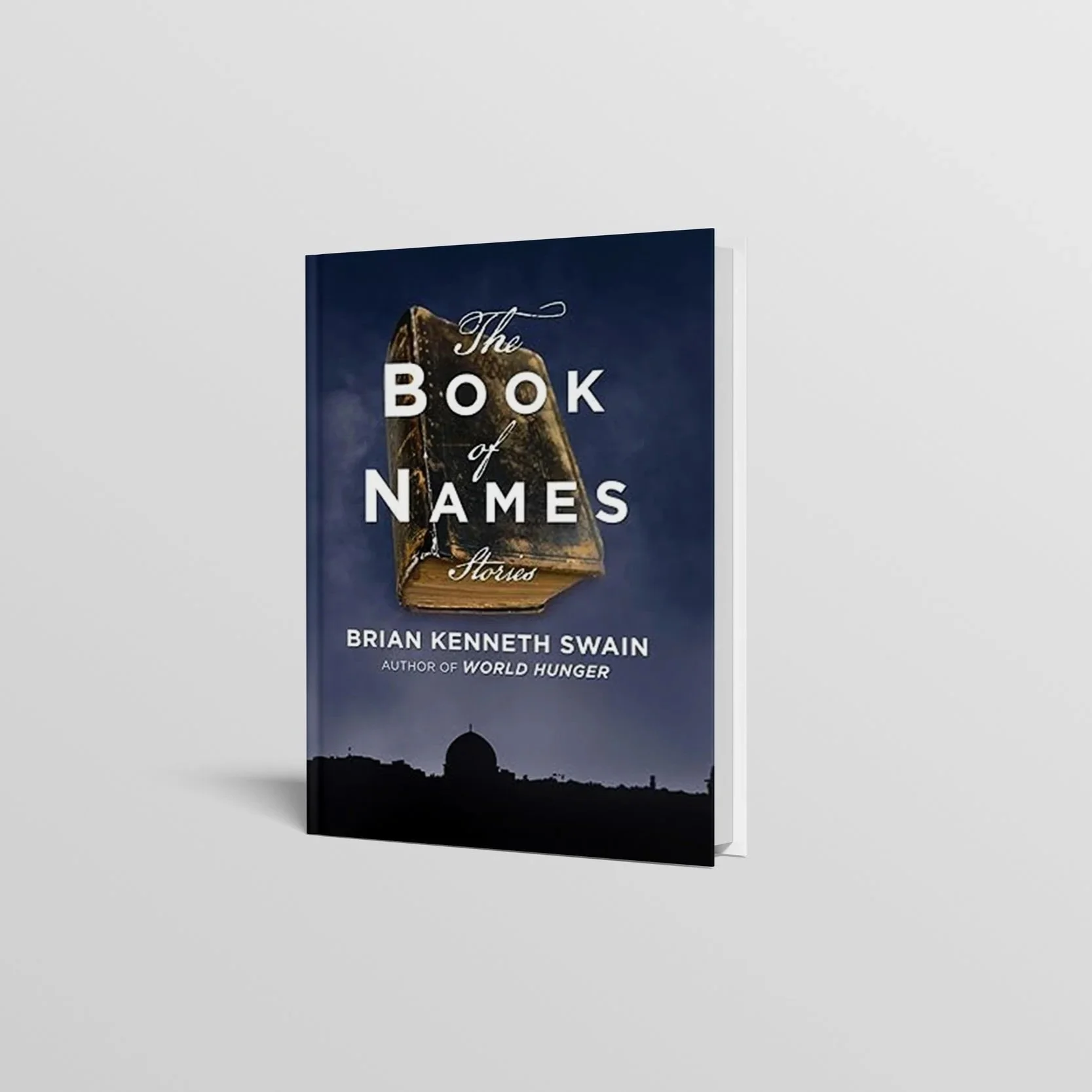
The Book of Names: Stories
From the author of Sistina, Alone in the Light, and World Hunger
The Book of Names is Brian Kenneth Swain’s first collection of short fiction. The stories, characters, and themes explored in this work are as universal as they are diverse: bravery, greed, legacy, and a serious infatuation with horses and French horns. In the title story, one soldier turns hopelessness into a moment of grandeur and sacrifice. In “The Antique Shop,” the proprietor and his customer marvel at the absurdity of debating the provenance and value of a book that cannot possibly exist, despite it being there in the shop with them. And in “Convergence,” two Middle Eastern men share a drink and speak of the inestimable loss each has suffered in a recent terrorist attack, and the terrible secret that binds them together. Swain dissects with candor and immediacy the emotions and motivations of his characters, whether in response to dowsing a well, opening a hamburger shop, working to thwart child abusers, talking a friend off a ledge, or shopping for one’s own casket. The people are instantly recognizable, the fears and joys are boundless, and the language is imbued with empathy, honesty, and humor. The inhabitants of The Book of Names are your neighbors, your friends, your family, possibly even yourself.
The Book of Names - Excerpt
“He just fell over dead in mid-sentence, not two feet in front of me. And this on a day that had actually been relatively uneventful to that point, as least as these days go. Couple of inconsequential skirmishes. No casualties or injuries at all, in fact, aside from Flanders there, who sprained his ankle dodging a mortar round. We were all sitting around over by the depot, winding down a bit, but taking the usual precautions—sand bags, trip wires, couple of lads on watch up top. Preston and I sat off to one side, drinking a bit of that awful coffee he made, and he was telling me about this boat he bought just before signing on and how he’s going to go home and fix it up once we’re done fighting. And just as he gets to the part about how he’s going to muster up his nerve and make a run at some girl he knew from high school, take her out on the boat and whatnot, there comes this hiss—you know the hiss—and the round takes him straight in the left ear.
“He never felt a thing. Of that I can assure you, Brother. But here’s the weird bit. I remember—don’t ask me why—that his last word on this earth was ‘I’ll.’ A bit sad to see life end on such an optimistic note. Never made it to the end of the sentence, so I’ve no idea what he meant to tell me. Something about either the boat or the girl, I expect. Preston was a good one, a hell of a good one, and he’ll damned well be missed.”
Bates had just come in off patrol and was relaying the key points of the trip. The four-man scouting mission had now become three, and he and the two remaining members had taken turns shouldering Preston’s body back with them, which was doubtless no easy task, since they’d been more than a mile from camp when it had happened. He paused for a long moment, turning his expressionless gaze toward the ceiling, reflecting, I suppose, on what must surely have been a horrific image. Yet he seemed to take the whole thing with a bit more equanimity than most. I suppose that’s due to the extreme number of casualties he’d witnessed. In fact, I knew that he’d kept careful track of them all during his years in combat. He’d explained to me some days earlier that he carried a written record of every casualty he’d personally witnessed. Not a lot of detail—just time and date, location, and a brief statement of what happened: gunshot, landmine, that sort of thing. I was a bit taken aback when he confessed that he’d personally witnessed the deaths of fifty-four soldiers, along with an additional eighty-three wounded. The rebellion was now nearly four years old and it seemed he’d been around for the better part of it.
But here’s the thing—he really didn’t need the written record. If pushed, he could recite every last name in his book, along with all the other salient details of each case. He didn’t get into the why of it, but I took it to be his personal way of coping. He was simultaneously recognizing each man’s sacrifice by keeping the records, while also shielding himself from the horror of the situation by boiling it all down to a handful of simple notes. Not only did he know every nuance of each man’s case, but he could recite a wide range of statistics about the data in aggregate. He knew the exact percentage of men who had died from gunshots, mortar rounds, or landmines. He could quote you the distribution of their ages. Hell, he even knew the breakdown of which areas of the country they’d come from. Seemed like the more he embraced the numbers, the less he had to think about the faces.
I saw his book one time, though it was accidental and I don’t guess he much appreciated it, as he quickly slid it back into his breast pocket the moment he spied me looking at him. I remember thinking how odd that reaction was, what with him having been the one to tell me about it in the first place. I guess knowing and seeing are different things to some people. Before he had noticed me watching, I stared fascinated as he scribbled in it with the dregs of a pencil so small he could scarcely hold onto it. The book itself was a minuscule thing, no thicker than your little finger, no taller or wider than a pack of cigarettes. The cover was an ancient-looking cracked leather material that had once been black, but that had evolved to a sun-bleached gray. Truth be told, it looked like a tiny Bible. I didn’t get much more than a glance before he hid it away, but what little I saw of the two pages he had it open to looked as though he had dedicated one full page to each individual. Aside from an almost identical format of information for each man, there was a curious smudge in the lower right corner of each page. I wouldn’t learn the significance of this until sometime later. It also seemed that, as he wrote, he had the book open to a spot nearly at the back, which caused me to wonder what his plan was if he ran out of pages before we ran out of casualties. I did not think it prudent, though, to ask. That question would be put to the test soon enough.
I enjoyed this book very much, and would highly recommend it!! Swain's collection of short stories was a refreshing change from novels in which chapters sometimes seem to go on and on forever. Each story was totally different and diverse than the previous one, so always an interesting surprise. It is well written, and I am happy to add it to my library!
Brenda Veale, Amazon Review
If you like light reading, don’t buy. Good story line, held my interest, and none of the poor editing seen everywhere today. Engaging, assumes the reader is very well educated with a love of good literature.
Mimi, Amazon Review