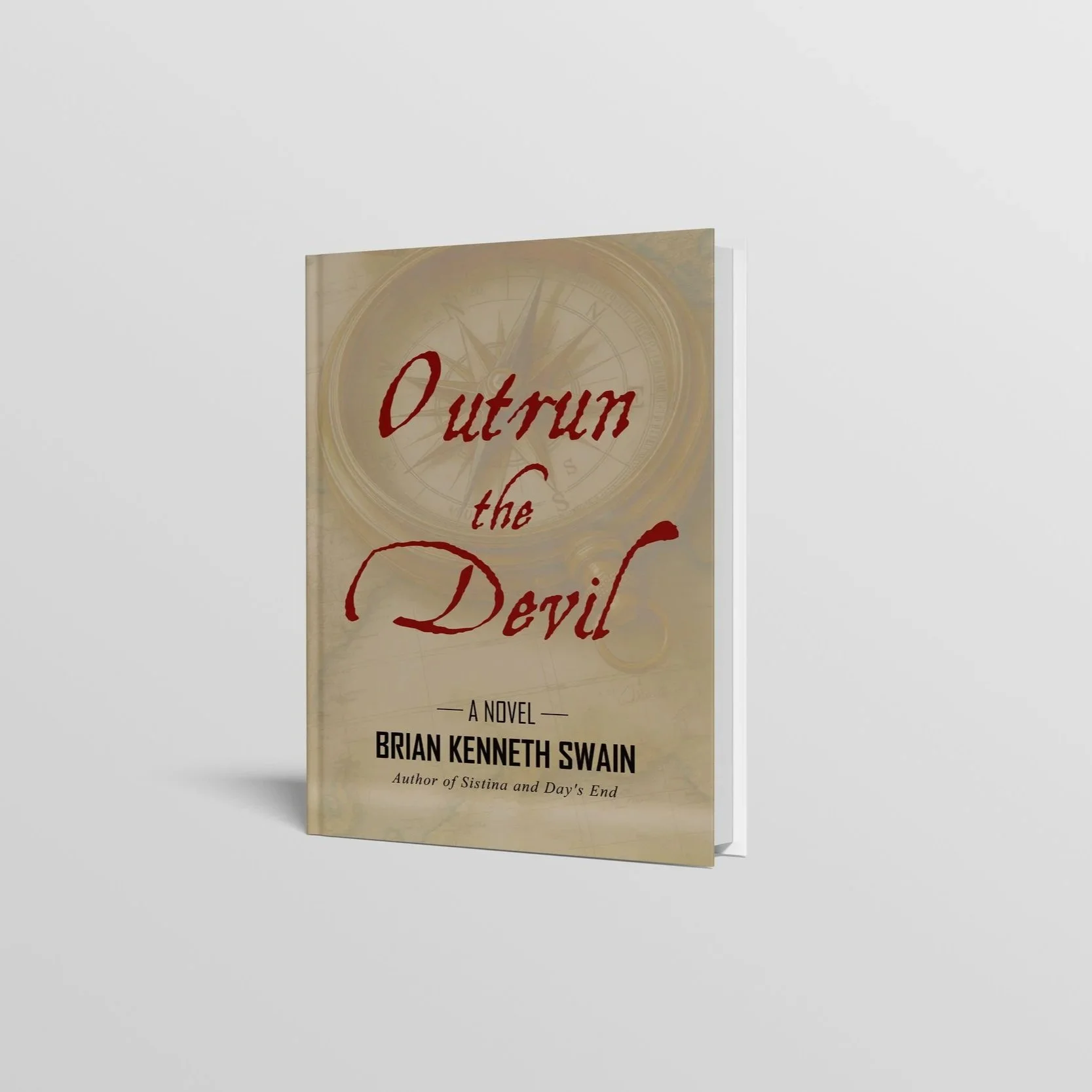
Outrun the Devil
Two interwoven stories. One voyage of discovery.
It’s late summer of 1492 and a bold explorer named Cristóbal Colón sets out on an unprecedented adventure to discover a New World and carve his name in history. Joining his intrepid crew is a young man fleeing the ravages of the Inquisition while also striving to find his own path in the world. But also secretly onboard is a leader of the Church, committed to ensuring that the young man fails in his ambition, desperate as well to ensure his own place in the Inquisition hierarchy, even if it means sacrificing his mortal soul.
Nearly 500 years later, a Dominican man flees his native land in the dark of night following the assassination of the country’s tyrannical leader and subsequent pursuit by that country’s vengeful protector. Making his way to America, the man flees from one danger, only to draw inexorably closer to another.
The two stories, separated by the centuries, are linked in ways both tragic and astonishing. The characters are real, as are all the emotions, the aspirations, and the fears. Outrun the Devil is a story of discovery, terror, love, legacy, and just a touch of magic.
Outrun the Devil - Excerpt
September 30, 1480
Miguel de Morillo cannot say for certain who he is. Though he frequently contemplates his visage in the single small mirror of his apartment bath, and though his forty-seven years of life have given him plenty of time to consider the matter, he feels no closer to understanding himself and his purpose in this life. Surely I have one, he thinks, gazing intently into the bronzed glass. His eyes are deeply set and closer together than seems to him normal. Most disconcerting of all, the irises that on others are blue, brown, or hazel, are, on Morillo, so entirely dark that they appear black like the pupils ensconced within their radius, the resulting effect on those he meets being entirely that of peering into the abyss of a deep well. It disturbs even Morillo himself as he stares into the glass. My God, he thinks, I am a hideous man.
While Morillo surely overestimates the magnitude of his deformity, there is no minimizing the effect of his gaze, particularly upon the uninitiated. No one—neither parishioner nor priest—maintains eye contact for more than a few seconds, if brave enough to initiate it at all, for his mien is both sanctimonious and penetrating. Yet despite this daunting aspect of his physiognomy, Miguel de Morillo, Master of Theology and Commissary of the Holy Office, is nevertheless highly regarded by both parishioners and his fellow clergy members of the abbey. If he is a daunting interlocutor, it stems principally from his unchallenged competence. If his manner is occasionally overbearing, it surely derives from the rigor with which he embraces his clerical vows and the complete contempt he reserves for those he believes have not used to the fullest the gifts that God has so magnanimously bestowed upon them. Into this latter category, he lumps many that others, including his ecumenical colleagues, would simply dismiss as downtrodden or unfortunate. He has, or imagines he has, genuine sympathy for those whom life has afflicted with one or another physical ailment that renders them unable to manage for themselves. But he has no tolerance at all for those who appear healthy yet spend their days in the streets as mendicants. Many regard such views as unworthy of the clergy and Morillo does his best to keep them to himself.
Throughout his tenure as priest, Morillo has been widely regarded as one to be emulated. If he has a flaw, it is his ambition, which he makes only the faintest of efforts to conceal, and which has doubtless been largely responsible for his elevation to Vicar of the Iberian Dominican Order three years hence. Ambition, or at least its public manifestation, is frowned upon by the Church leadership, yet Morillo justifies his with the assertion that the higher he rises in the Church hierarchy, the more good he can promulgate to his fellow man during his limited days upon this earth. A natural condition of his ambition, and another decidedly un-clergy-like characteristic, is that he is given to fits of jealousy, most recently over the letters he has received from Alonso de Ojeda, a fellow Dominican in Seville, and a man who has, by means unclear to Morillo, managed to ingratiate himself with the King and Queen. Still, Ojeda is largely responsible for Morillo’s new position, for it is Ojeda who convinced the royals of the infestation of conversos on the Andalusian peninsula and of the pressing need to request of His Holiness the power to appoint Inquisitors to ferret out this evil. The resulting papal bull, released by Sixtus on November 1, two years earlier—the Exigit Sinceras Devotionis Affectus—had bestowed upon the monarchs the exclusive power to name those who would serve as Inquisitors throughout the kingdom. It had taken two long years for the call to come, but come it had, and he and fellow Dominican priest Juan de San Martin would begin that effort this very day.
Turning away from the mirror, Morillo prepares a simple breakfast of bread, goat cheese, and tomato. Today is an important day and he has made an early start of it, rising before the sun in anticipation of the momentous events to come. Morillo’s appointment is not a promotion, but it is a highly visible assignment, one that may easily contribute to his subsequent elevation so long as he succeeds in the Inquisition’s mission, a mission that he and San Martin will be charged with defining in the coming days and weeks. At a high level, their purpose is clear and unimpeachable—identify the conversos and, if they are found to be genuine Christians, but merely backslidden, either bring them back into the Church’s embrace or ensure—using whatever means may be required—that they cannot serve to influence others in their iniquitous ways. And if, as Morillo and others suspect, the conversos were never genuine to begin with, then expunge them from the body of the Church and, indeed, from the Andalusian peninsula entirely. It will be the operational details that require defining. What rules will govern the fraught process of identifying and extracting the truth from the thousands of individuals currently poisoning the Church’s holy work throughout Andalusia? How best to convince the unwilling not only to confess their own wayward actions, but, as well, offer information on the activities of others—their family members, friends, and business associates? To succeed in this endeavor will require a delicate balance between sensitivity and ruthlessness, nuance and zealotry. Morillo feels confident in his capacity to provide the necessary measure of zealotry, but no one has ever accused him of being overly sensitive or nuanced.
He does not know his fellow Inquisitor well. The two priests have met only twice before, and the most recent occasion was nearly three years ago. San Martin has traveled from Seville to meet this day and to begin working with Morillo, who has himself traveled from his home to Medina del Campo to develop a strategy that will carry the Church's message to the masses while also searching for the conversos. As he sits eating, Morillo gazes again upon the pontiff’s missive, delivered by messenger only a week earlier. Even the initial notice of his appointment, which he had expected to produce a measure of satisfaction, had, instead, carried a whiff of the balancing act the priest would be called upon to demonstrate repeatedly in the coming days. For while the confirmation of his appointment had generated feelings of pride, vindication, and opportunity, he couldn’t help but notice that San Martin’s name had appeared before his own in the monarchs’ flowing appointment text. And yes, they were peers in the endeavor, a relationship made clear in the text. But Morillo was nearly ten years San Martin’s senior, both in age and ecclesiastical tenure. The King and Queen were certainly aware of this fact, yes? Surely a bit of acknowledgment was not too much to expect.
He looks once more at the letter, then folds it up. Letter be damned—Morillo knows who will run this affair, and he knows, as well, whose name will be chosen when the time arises—as surely it must—to name an Inquisitor General.