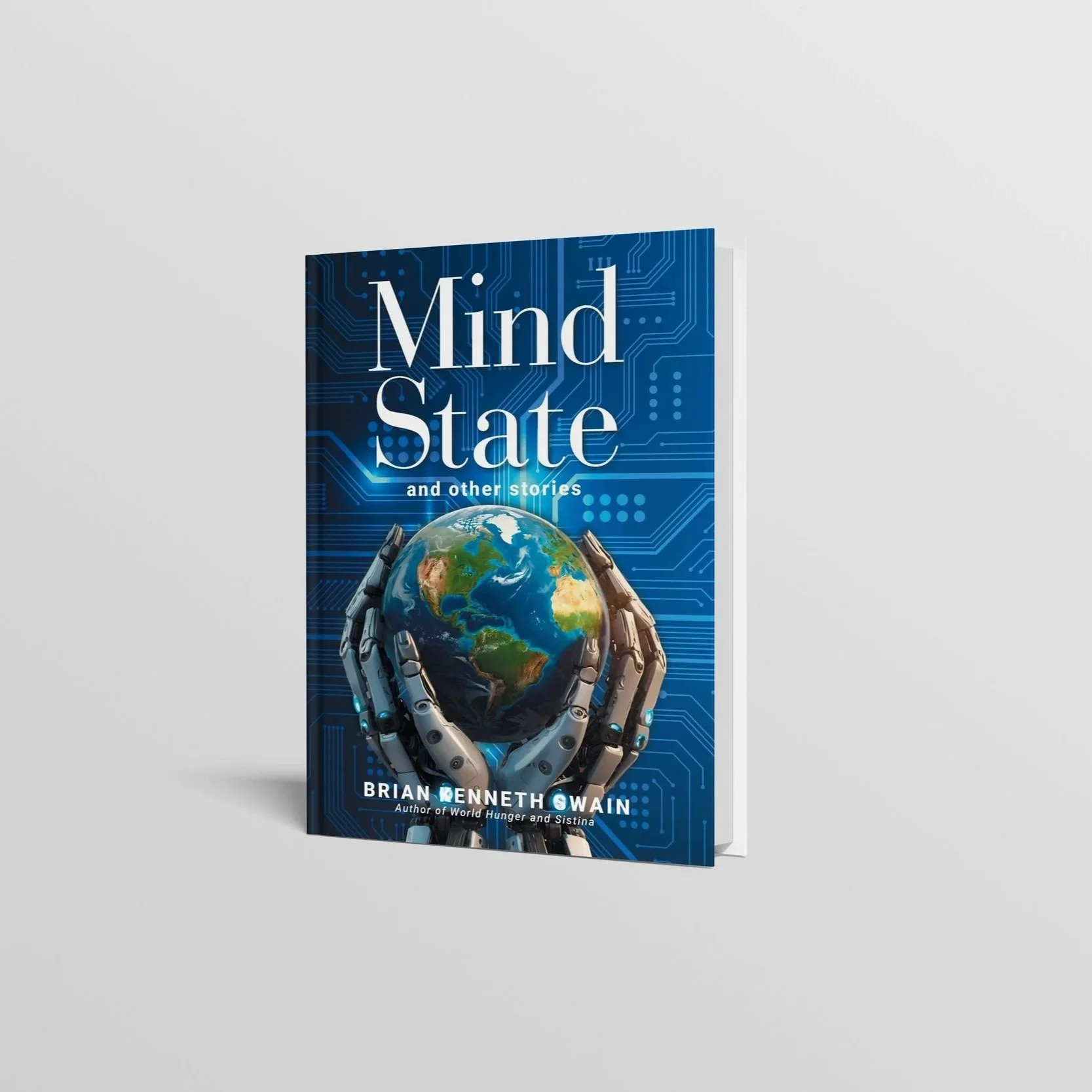
Mind State: Stories
Mind State is a new collection of imaginative and thought-provoking tales from the author of Day's End, Sistina, and World Hunger.
In Icarus Falling, a routine lunar supply mission turns into a hellish journey whose end can only be carnage, for the crew and for everyone awaiting their arrival.
In Eliot's Ghost, a business executive must finally face the consequences of a long-forgotten decision as he searches for a mysterious, long-lost worker whose tormented spirit fills his dreams.
And in Arwen, a young woman shopping for books meets an unexpected stranger, one who shares wonders beyond her imagining and, in the end, leaves her with a truly unexpected gift.
Swain's second collection of short fiction is a journey unlike any he has taken us on before. The stories bring to life characters who face seemingly insurmountable obstacles, delivering moments that range from unexpected bliss to abject terror.
Mind State is more than just suspenseful fiction. The people are real, the challenges immense, and the outcomes beyond the unexpected, possibly even beyond comprehension. The stories that comprise this astonishing collection will make you rethink the values and beliefs you hold dearest, and quite possibly even change your views about not only cause and effect, but also right and wrong.
Mind State - Excerpt
MindState
“Cut the links!” Bethel says without hesitation, his voice far calmer than the situation would seem to merit. “Cut them all now.” But as Ryker the technician raises his hands to the keyboard to comply, Bethel raises a hand. “All but Sydney,” he says. “That was Stewart’s original destination. Leave that link open. Cut all the rest.” Ryker hesitates, as though unsure of Bethel’s resolve. The large time clock on the wall reads plus twelve minutes and thirty-seven seconds since transmission. “Do it, for Christ’s sake!” Bethel repeats, finally allowing a touch of urgency to enter his voice. Seconds later, six of the seven bars on the computer screen change from green to flashing red. A message appears on the screen:
“Are you sure? This operation cannot be undone.”
Ryker inhales sharply then lets his finger fall onto the return key. The six red lines flash once, twice, then go solid bold red. He turns in his chair to face Bethel. “That’s it,” he says quietly. “We’re out.” There is a look of genuine shock on the young technician’s face. “What now?” he says.
2 Hours Earlier
Devon Stewart darts from his car through the dense downpour and under the portico in front of the MindState building. He shakes the water from his jacket collar and slicks back his hair. He wears jeans and an open-collar dress shirt and carries beneath his left arm a thin portfolio containing business papers and a laptop computer. It is just past seven and early evening thundershowers in south Florida are a routine occurrence, but, unlike at Miami International Airport, where this sudden squall will ground flights for the next two hours, he has been assured that the weather will in no way affect the journey on which he is about to embark. Stewart trusts that this promise proves to be accurate. He has a critical business meeting in Sydney, Australia in less than two hours time.
Inside, in the lobby, he steps to the slick stainless steel counter and with a smile and subtle nod of greeting extends a hand toward the receptionist, a hand containing a thin metallic card with a computer chip embedded in its center. There is no writing on the card or other markings of any kind. The receptionist smiles and nods in reply, accepts the card, and inserts it into a reader. Stewart’s image and itinerary appear instantly on the screen before her. She taps the screen with two practiced gestures, then turns back to face him.
“Welcome to MindState, Mister Stewart. We are right on schedule. Your attendant will be with you in just a moment. In the meantime, if I can borrow your papers, passport, laptop, and any other documents you want transferred, I’ll get them all uploaded and ready. One less thing to worry about later.” Stewart hands her the portfolio. “Have a seat,” she says, “and Mister Bethel will be with you shortly.” This will be only the second time that Stewart has met Christopher Bethel. The first had been the previous week during the briefing where the MindState process had been described in all its fantastic detail.
5 Days Earlier
“Mister Stewart, good morning! A genuine pleasure to finally meet you.” Bethel, dressed in a near-skin-tight suit that looks like a cross between a chef’s jacket and an Italian designer suit, exudes confidence and professionalism as the men sit alone in a large conference room. There is a display screen at the front of the room, currently showing the MindState logo, rotating in high-resolution three-D. Before Stewart there lies a thin folder containing the promotional literature describing MindState’s various service offerings. But he won’t need to read the colorful pages. That’s what Bethel is here for.
“Mister Stewart, I don’t want to take up too much of your time, as I know you’re a busy guy. Also I expect you may have heard at least some of the details about MindState from the associate who recommended you to us. Nevertheless, as this is your first trip, I’ll just take a few minutes and go through the highlights of the experience so you know what to expect. Then if you have any questions, either now or before you leave on Monday, I’ll answer those as well.
Two weeks earlier, Devon Stewart’s company, a large electric power provider serving the southeastern portion of the United States, had completed all but the final terms of a very large business deal with a technology company in eastern Australia. Devon had been assigned the task of flying to Sydney to complete the transaction and returning home with a signed contract. The deal was valued at nearly one hundred fifty million dollars over its five-year term. And while the opportunity to negotiate and finalize such an immense deal was a great career move for Devon, the prospect of thirty hours of flying in each direction had proven somewhat less than enthralling—five days of traveling for what would amount to a single two-hour meeting. He’d mentioned that annoying detail to a department colleague over lunch the following day.
“So screw the flying,” the colleague had immediately responded. “Just do MindState. It’s approved by accounting now. Costs about the same as business class, but no jet lag, no wasted time. It’s pretty awesome, I gotta tell you. I’ve gone three times with them. Any flight longer than two hours, you’ll never go back to airplanes.”
Devon had heard about MindState through the grapevine, but it was a relatively new service and he’d never taken the time to learn the details. Hence today’s visit.
“So, first of all, how does it actually work?” Bethel begins. The display changes to a split-screen photo. On the left a man appears to be asleep in a high-tech recliner. A thin silver dome covers the upper half of his head. On the right, another man stands smiling in full suit and tie, briefcase hanging from one hand. In the background are palm trees and what looks like a hotel.
“With MindState you are transported to your destination of choice, but without ever actually leaving home. The process is nearly instantaneous and the distance doesn’t matter in the slightest.” This assertion elicits a furrowed brow from Devon.
“Think of it as being about halfway between flying conventionally and those teleportation devices you used to see on science fiction TV shows. MindState currently has arrival and departure ports in forty-seven cities around the world, with more coming on line every day. Miami is one of six in the U.S. Conveniently for you, Sydney is one of two in Australia.”